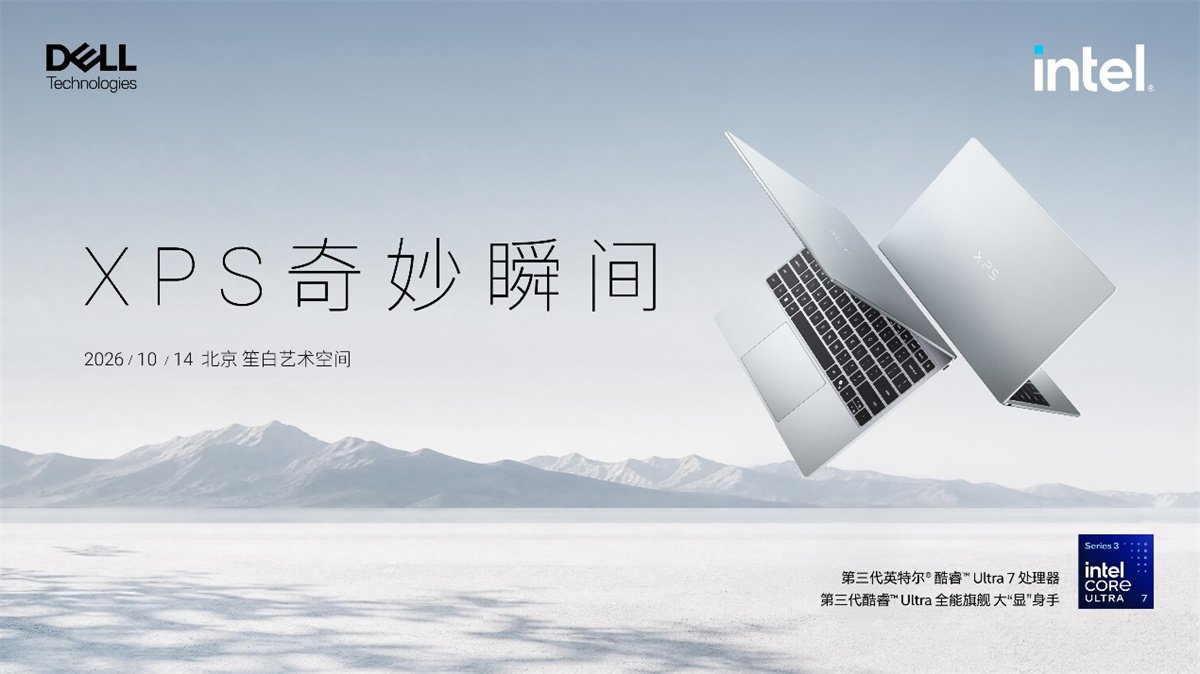
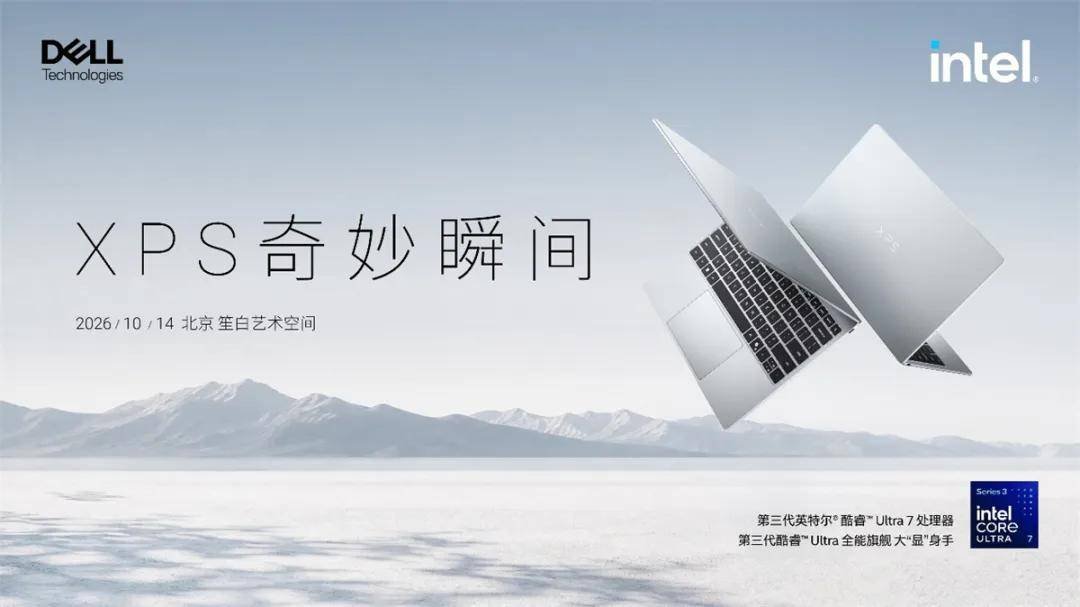
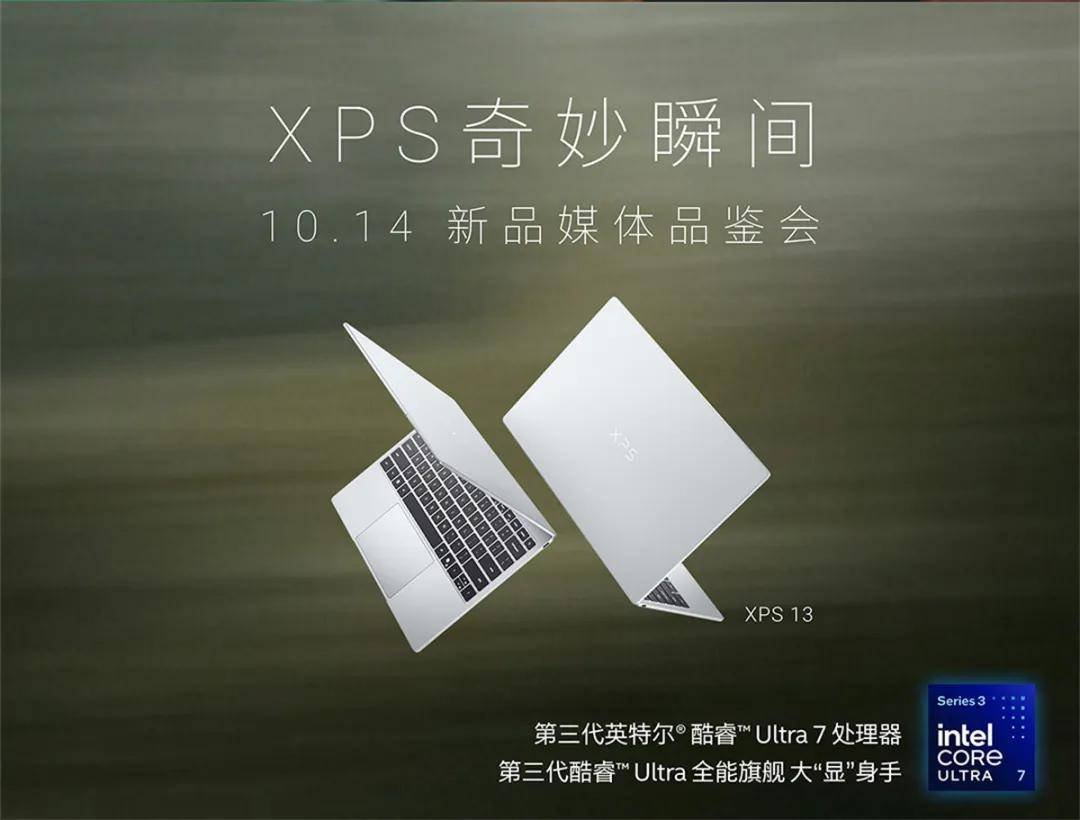
On the afternoon of October 14, the Dell XPS "Extraordinary Moments" new product media preview was held at Sheng Bai Art Space on Chaoyang North Road in Beijing. This preview, set against an autumn backdrop and themed "A Journey of Ultimate Performance and Technological Aesthetics," had only one true star: the all-new Dell XPS 13, which returns to the Chinese market this year.
About 1 kg, 12.7 mm at its thickest point: the perfectionism behind thin and light
As "the lightest and thinnest model in XPS family history," the new XPS 13 weighs approximately 1 kg, measures 296.9 mm × 200.66 mm, and is 12.7 mm at its thickest point. Particularly worth noting: 12.7 mm refers to the thickest point at the fan location after excluding the feet, rather than the "thinnest point at the front edge" commonly used by many manufacturers. Behind this difference lies a different design goal—making a machine thin is not difficult; what is difficult is making it thin without sacrificing performance.
The chassis is made of CNC-machined aluminum alloy and comes in two colors: Sky Silver and Stellar Gray. It features a backlit keyboard and a touchpad with clearly defined zones, and can be opened with one hand effortlessly. The iconic XPS series logo has also returned to the center of the lid.
Air intakes "hidden" on both sides: an easily overlooked engineering detail
Flipping the laptop over reveals a completely flat, seamless metal surface on the bottom—the new XPS 13 has eliminated the bottom intake grille commonly used in traditional thin-and-light laptops and instead draws air in from both sides of the chassis.
This change addresses a very specific high-frequency user scenario: when the laptop is placed on a lap, sofa, bedding, or other soft surfaces, bottom intake vents are easily blocked by fabric, causing the chassis to heat up and fan noise to increase. The new XPS 13, combined with dual fans, graphite heat-spreading material, and localized thermal insulation design, uses bypass airflow to assist cooling, allowing heat management to remain stable within an ultra-thin space. Although the two processor platforms share the same chassis, the motherboard and cooling structure are adapted separately for each.
15W and 25W: two platforms, the same 35W peak
In terms of performance, the new product offers two processor platforms: the 3rd Gen Intel Core processor (Core 300 series) built on Intel 18A process, with sustained performance release of 15W; and the 3rd Gen Intel Core Ultra processor (Core Ultra 300 series), with sustained release of 25W. The peak power of both platforms is anchored at 35W.
The display is another clear investment. The new XPS 13 features a 13.4-inch 2560×1600 touchscreen, continues the InfinityEdge narrow-bezel design, covers 100% DCI-P3 color gamut, reaches a maximum brightness of 500 nits, and supports a 30–120Hz variable refresh rate. Notably, the touch layer is integrated into the slim top cover, and even the 16GB entry configuration comes standard with a touchscreen—there is no need to select a different display version just to get touch functionality.
For battery life, the new XPS 13 has a built-in 52Wh battery, offering up to about 17 hours of streaming playback; mixed daily office use and light entertainment can last about 12 hours. With a 65W USB-C GaN adapter and ExpressCharge fast charging, short business trips may not even require carrying a separate charger.
In terms of ports, the new XPS 13 Core version offers USB-C ports supporting DisplayPort and power delivery, while the Core Ultra version offers Thunderbolt 4 ports.

"Back to 2015 prices": a third path of no price increase for ten years
At this preview event, product pricing was one of the focuses of greatest interest to the media. The main configuration promoted in China is the Core 5 320 processor, 16GB memory, and 512GB SSD; the series also offers the Core Ultra 7 355, up to 32GB memory, and 1TB storage. The starting price of the XPS 13 remains in the 8,000-yuan range, with the China entry configuration priced at 8,999 yuan, which enters the 6,000-yuan range after national subsidies.
Regarding product pricing, Ye Chengwei, senior product manager for notebooks at Dell Technologies Group, repeatedly emphasized one number: "The XPS 13 we sold in 2015 and the XPS 13 we sell today are at the same price." Zhang He, senior product marketing manager for notebooks at Dell Technologies Group, said that in the past consumers' impression of XPS was good build quality, good performance, and also a high price, while this year Dell hopes to lower that threshold.
This positioning is quite meaningful in the context of the 2026 PC market: on one end, prices of core components such as CPUs, DRAM, and SSDs have risen for multiple consecutive quarters, putting upward pressure on average selling prices of complete machines; on the other end, the replacement cycle for consumer thin-and-light laptops continues to lengthen. Manufacturers' common choice is to cut features at a fixed price point, while the XPS 13 attempts a third path—retaining the CNC unibody chassis, 2.5K touchscreen, and dual-fan cooling, while using engineering and design optimization to absorb costs.
In terms of product line layout, Dell's intention is equally clear: the XPS 14 and XPS 16 continue to serve users with higher budgets, while the new XPS 13 at a lower price point is responsible for bringing this experience to students and young people just entering the workplace, with the three products forming a complementary lineup.
From the official announcement of the XPS series' return at CES early in the year, to the China market launch in June, and now to the in-depth interpretation at this media preview, the new XPS 13 has put the high-end emblem back in the center of the lid while pulling the price threshold back to ten years ago. This also reflects a clear judgment by Dell about the current PC market: under the dual squeeze of rising costs and contracting demand, Dell has chosen to use engineering design rather than configuration cuts to better meet consumer needs.


