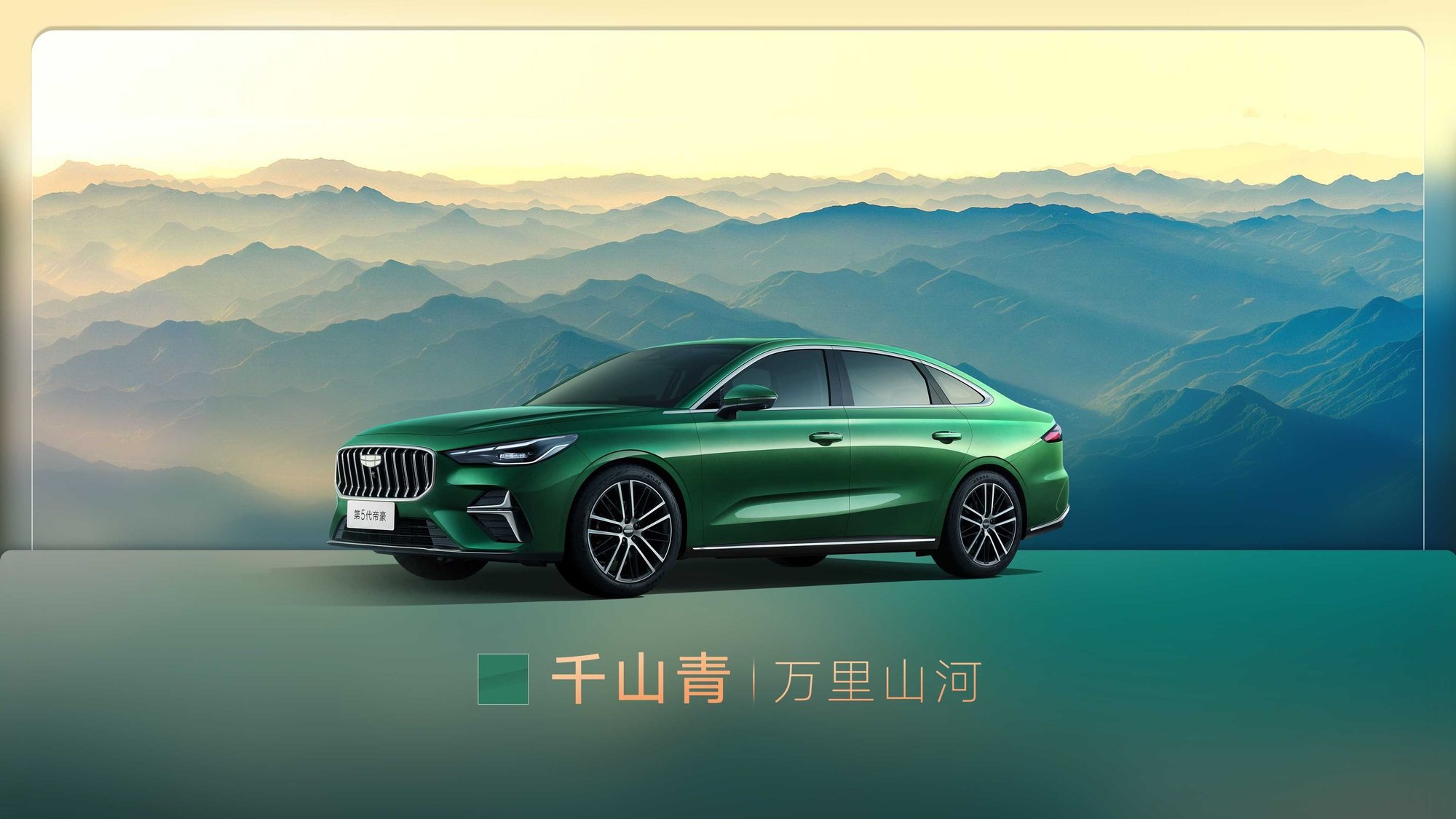
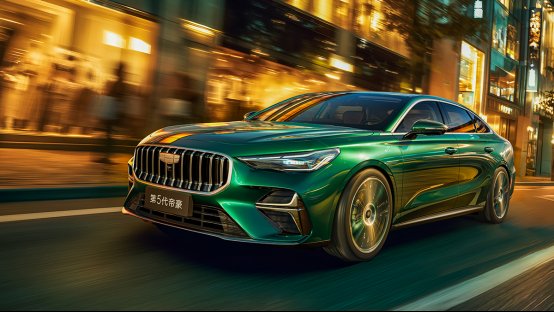
Some people say that the launch of the 5th-generation Emgrand is just "another cheap compact family sedan."
The official keywords are quite plain: a guide price of 74,900-91,900 yuan, a limited-time gratitude price of 65,900-82,900 yuan, two powertrain options of 1.5L+CVT and 1.5T+7DCT, the Flyme Auto intelligent cockpit, a 2755mm wheelbase, and an 85.1% "space utilization rate."
But if you slow down and look at these cold numbers a little more carefully, you will find that what the 5th-generation Emgrand is saying may not just be about "value for money." It is more like a microcosm of ordinary Chinese families in the 2020s - in a life with limited budgets, hurried time, and choice overload, trying to find for themselves a sense of certainty that is **"just right."**
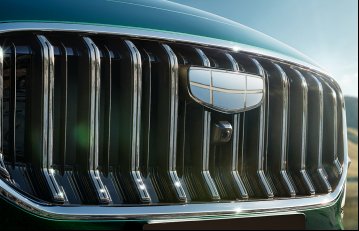
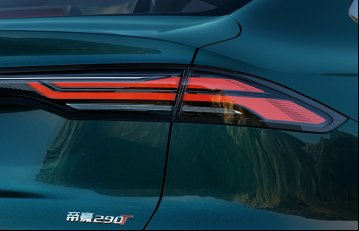
I. The sense of time in "5th generation": the car is changing, and so are we
From the first-generation Emgrand to today's 5th generation, it has roughly spanned the period of your life from "a new worker" to "carrying a mortgage and the responsibility of raising a family."
The early Emgrand was saying, "We can also build a decent family sedan";
the 5th-generation Emgrand is saying, "In an era where new energy and intelligence are surging in, what kind of reassuring fuel-powered car can we still leave for ordinary people?"
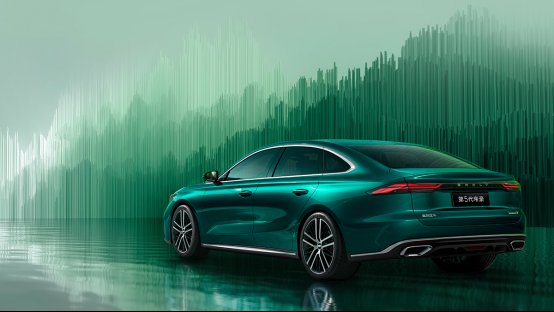
A body length of 4815mm and a wheelbase of 2755mm have quietly approached the size of what used to be called "A+ class," yet it still quietly places itself in the "compact car" category.
This is a very Chinese-style state:
not shouting "I want to transcend my class,"
but in the details, pushing the boundary a little farther, bit by bit.
It is like the mindset of many people after they reach their thirties:
no longer needing to prove anything to the world, only hoping - within the range of one's abilities - to do the things in one's hands a little better, and then a little better still.
II. Starting at 65,900 yuan: is being cheap really the greatest advantage?
Starting at a limited-time price of 65,900 yuan, this number makes it easy to blurt out:
"At this price, it's enough, as long as it drives."
But the two words "enough to use" are actually one of the hardest propositions for ordinary people.
You can choose to grit your teeth and go up to over 100,000 yuan to embrace a larger SUV or a plug-in hybrid sedan;
or, like many families, you can see the car as a tool for "commuting + grocery shopping + picking up and dropping off children," with the budget more willing to be left for mortgages, education, and health.
The 5th-generation Emgrand chooses the latter:
it does not stack up features that look cool but are used very infrequently,
but instead spends money on the things most easily perceived -
a larger size, more comfortable seats,
a complete and easy-to-use infotainment system,
and an optional assisted driving package that can make you a little less tired on the highway.
Philosophically speaking, this car seems to be asking:
in an era desperately selling you "bigger, stronger, more luxurious,"
do you have the courage to pay only for the life you truly need?
III. The "late twilight" and tenacity of fuel-powered cars: the realism of 1.5L and 1.5T
At a time when new energy topics have already filled the trending searches, the 5th-generation Emgrand is still a purely fuel-powered car, and very candidly so:
1.5L naturally aspirated + CVT, 88kW, 150N·m
1.5T turbocharged + 7DCT, 133kW, 290N·m, 0-100km/h in 7.9 seconds, fuel consumption about 5.95L
This set of data is not "stunning," but it is extremely "realistic."
For a family sedan, certainty is sometimes more important than "subversion":
no need to line up for charging or worry about charging spaces;
no need to worry about electricity consumption soaring in winter or range being discounted when the air conditioning is on in summer;
gas stations are always denser than charging piles, and your parents will always trust the needle on the fuel gauge more than a phone.
New energy is like the "vanguard" of this era,
while fuel-powered cars like the 5th-generation Emgrand are the "main force" in the lives of countless families.
It reminds us:
the era is indeed moving forward, but not everyone has to stand at the forefront,
for the vast majority of people, "being able to pick the child up and get home on time" is more important than "how many seconds from 0-100km/h."
IV. Intelligent cockpit: the screen got bigger, but is life clearer?
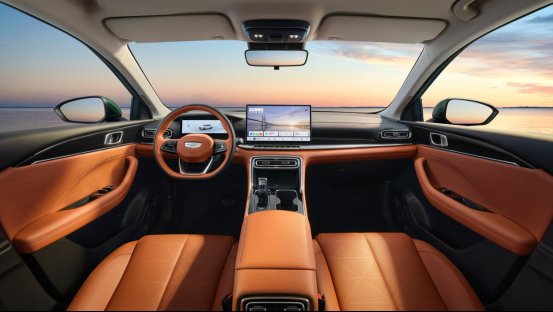
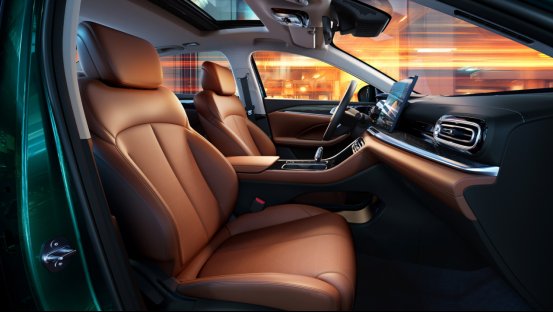
In the interior of the 5th-generation Emgrand, the most eye-catching thing is not some trim panel, but the Flyme Auto intelligent cockpit:
10.25-inch LCD instrument cluster
14.6-inch high-definition central control screen
small-window multitasking, SmartBar quick interaction, full-screen gestures, full-scenario voice
support for Carlink and HUAWEI HiCar seamless connection
From the feature list, this is already getting closer and closer to the experience of many new energy vehicles priced over 200,000 yuan.
But interestingly, the smarter the infotainment system becomes, the more we instead need to ask ourselves a question:
when navigation, music, socializing, and work can all be accessed through this screen -
during these 30 minutes or 1 hour in the car,
do you want to continue being chased by information,
or do you want to allow yourself to quietly do just one thing?
What Flyme Auto provides is a possibility:
making your car no longer an "information black hole,"
but a space where you can customize the "flow of information."
You can:
let navigation, music, and a small amount of information run in parallel,
or with one voice command, make it all go quiet.
In an era when anyone can reach you at any time,
the inside of a car may be one of the easiest small **"controllable boundaries"** you can have.
The 5th-generation Emgrand uses an intelligent cockpit to tell you:
technology can stuff everything into this screen,
but you still have the power to decide whether or not to "interrupt yourself" today.
V. Space and "space utilization rate": whose life is being carried inside the car?
One very interesting indicator Geely gives for the 5th-generation Emgrand is an **"85.1% space utilization rate."**
This is a term that originally belonged to the real estate industry,
and when it is moved into a car, it suddenly has a bit of the flavor of a life metaphor -
the space in a car is limited,
how to allocate it to the front-row driver, rear-row passengers, and trunk is the engineer's choice;
a person's time and energy are limited,
how to allocate them to work, family, and self is a choice we make every day.
The rear row's 970mm headroom, 1480mm elbow room, and 1320mm seat cushion width show that:
this is not a car "designed only for the person driving," but a car designed for everyone in the car.
It assumes your life looks like this:
sometimes you drive alone, and the car is a mobile office;
sometimes you bring your parents, partner, and children, and the car is a temporary small living room;
in the trunk are vegetable baskets, suitcases, and also the little impulse for a certain "spontaneous weekend trip."
When you are choosing a car and struggling over "is the space enough,"
you are actually making a decision for the next three to five years of life:
How much room am I willing to leave for my family?
How much space am I willing to leave for myself so that looking back I will not regret it?
The answer Emgrand gives through its dimensions and layout is:
within an affordable budget, let everyone sit without feeling wronged.
VI. The 6,000-yuan H3 assisted driving: how much trust do you hand over to algorithms?
The 5th-generation Emgrand also offers an upward option:
equipped with the Qianli Haohan assisted driving H3 solution, with a limited-time optional "Upward Technology Package" priced at 6,000 yuan.
In product terms, it makes a "traditional fuel-powered family sedan" look up toward the era of intelligent driving;
in terms of usage scenarios, it is more like asking you:
are you willing to hand over a small part of control to an invisible set of algorithms?
When the vehicle automatically follows the car ahead and keeps to the lane on an elevated road;
when it helps you watch the distance to the car in front and monitor potential dangers;
you will slowly get used to this kind of relationship:
the steering wheel is still in your hands,
but you know that there is a system making a "second layer of judgment" somewhere you cannot see.
Philosophically speaking, this is a kind of "co-driving between human and machine":
we both want to control the direction and hope someone will pull us back when we are tired and distracted.
What 6,000 yuan buys is not a few functions, but this:
in an era of growing information noise and increasingly congested commuting,
are you willing to admit -
that human attention alone is no longer enough to resist all risks?
VII. Conclusion: the 5th-generation Emgrand, a life reply written to "ordinary people"
If the 5th-generation Emgrand were a person, it would probably be like this:
it will not boast that it is a "subverter,"
nor does it try to take you away from reality,
it just tries, as much as possible within a limited budget, to make the design not shabby,
the space not cramped,
the power not sluggish,
the infotainment not outdated,
and safety and assistance good enough that you do not have to "fight alone."
Buying a car looks like signing a financial contract,
but in essence it is writing an answer to your own life for the next three to five years:
how I plan to divide time between commuting and family;
how much I am willing to pay for "face";
whether I am willing to admit that I am actually just an "ordinary person,"
but still deserve a bit of dignity, a bit of comfort, and a bit of intelligence.
The appearance of the 5th-generation Emgrand is like a plain answer Geely has written to these questions:
you do not necessarily have to stand at the very forefront of the times,
but you should have a car that is dignified enough, smart enough, and stable enough,
to carry your ambition as an ordinary person who also wants to live well.