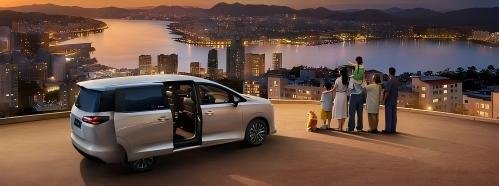
I. Architecture: An All-Energy Family MPV Under the Tianyu Platform
The Starlight 730 is not a simple "electrification conversion" on the old Baojun 730 platform, but an MPV developed on Wuling's native new energy architecture — the Tianyu Architecture. The three powertrain options — gasoline, plug-in hybrid, and pure electric — share a single body and chassis foundation structure.
There are two key points here:
Reserved layout space for three powertrains from the start
The front compartment must simultaneously accommodate the layout of a 1.5T turbo engine or a 1.5L hybrid-dedicated engine, the motor/e-drive assembly, PDU, etc.; the floor and rear axle areas must accommodate either a conventional fuel tank, a hybrid battery pack, or a large-capacity power battery.
For the engineering team, this directly affects layout completeness, frontal/side crash paths, and NVH performance — no small challenge. The upside is a high parts-sharing rate, making both overall vehicle cost and long-term maintenance costs easier to control.
The true meaning of "50+ items of gasoline-electric shared configuration"
The 50-plus "gasoline-electric shared configuration" items Wuling mentions are essentially integrated structural and electrical development: the same body-in-white, interior/exterior trim, and electrical architecture, minimizing parts differences across different powertrain types. This is friendlier for manufacturing, supply chain management, and after-sales service.
Simply put, the platform the Starlight 730 sits on was designed from the outset for "multi-energy co-line production," rather than cramming a battery pack into a gasoline vehicle chassis after the fact.
II. Body Structure and Aerodynamics: Six-Ring Cage Body + Low-Drag Details
1. Structural safety: 75.6% high-strength steel + six-ring cage
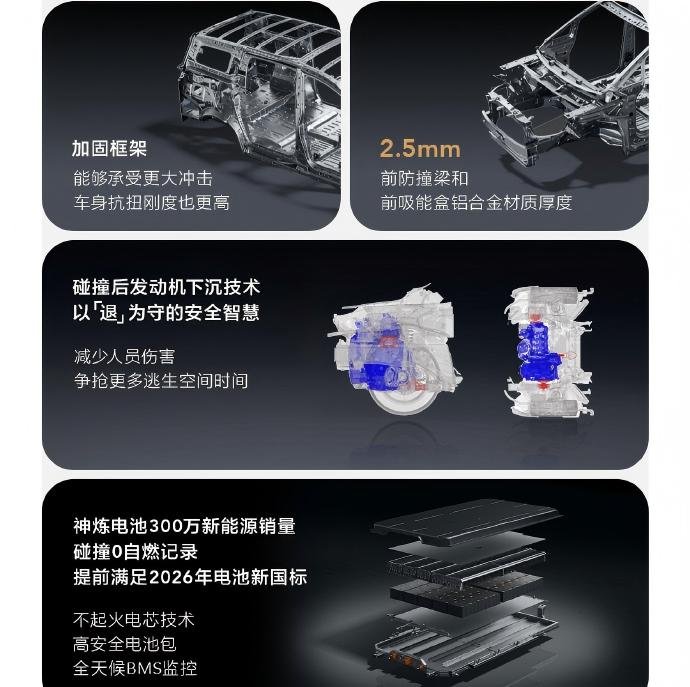
The Starlight 730 adopts a six-ring high-strength steel cage body structure, with high-strength steel accounting for 75.6%. In key areas such as the A/B/C pillars and rocker panels, 1500 MPa hot-formed steel is used. The front crash beam is a 2.5 mm aluminum alloy beam paired with a crash box.
The key to the "six-ring cage" is forming multiple closed rigid loops at the A/B/C pillars, rocker panels, and crossmembers, giving crash loads a continuous transmission path and reducing single-point failure risk. 1500 MPa hot-formed steel is typically placed at the A-pillar, B-pillar, and rocker panel areas to improve the occupant cell's resistance to deformation. The front crash beam and crash box are responsible for controlled deformation during a frontal impact, working with the engine drop structure to preserve survival space for the occupant cell.
In a 100,000-yuan-class family MPV, this ratio of high-strength steel and material specification is a fairly aggressive approach, showing a willingness to spend on the body-in-white cost.
2. Aerodynamics: the practical significance of achieving Cd 0.276
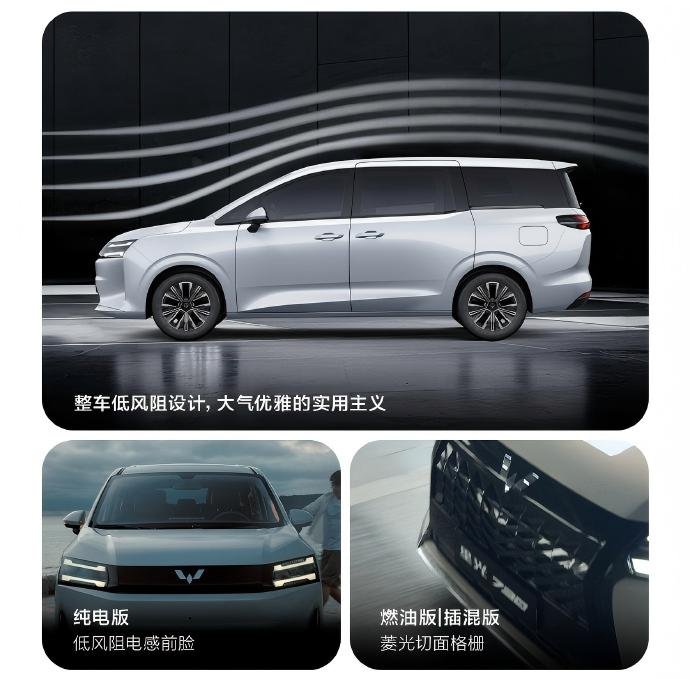
Information shows that the Starlight 730 has targeted aerodynamic optimization in details such as wheel covers, underbody panels, and front and rear wheel air dams, achieving a drag coefficient of 0.276 for the pure electric version.
For an MPV that is 4.91 meters long with a near "box" shape, this Cd level is already quite good.
There are two engineering benefits:
For the pure electric/plug-in hybrid versions, aerodynamic drag is the dominant energy consumer at highway speeds. For every 0.01 reduction in Cd, long-distance energy consumption and wind noise will see perceptible improvement;
For NVH, wind noise is one of the main noise sources for box-type vehicles. With solid aerodynamic optimization, the vehicle's high-speed quietness has a stronger foundation.
In other words, this vehicle's exterior is not just a matter of visual style — there are clear energy consumption and NVH targets driving the design behind it.
III. Powertrain: Trade-offs of One Platform, Three Assemblies
1. 1.5T gasoline version: a higher-output small-displacement turbo
The gasoline version is powered by a 1.5T LC4 engine with a maximum power of 130 kW and maximum torque of 290 N·m, featuring Miller cycle, dual overhead camshafts, and direct injection, matched to a 6MT or CVT transmission.
130 kW / 290 N·m in a family MPV is a calibration with fairly ample power reserves, with more consideration given to hill-climbing and highway overtaking capability when fully loaded with 7 people plus luggage. The high expansion ratio brought by the Miller cycle improves thermal efficiency, but requires coordination with turbocharging and variable valve control to balance low-speed response and driving smoothness while ensuring fuel economy.
In the 70,000–80,000 yuan price range, this powertrain's power level is on the upper end. NVH performance depends more on engine mounts, sound insulation, and calibration, and will need real-vehicle verification.
2. Plug-in hybrid version: the system approach of Lingxi Power 3.0
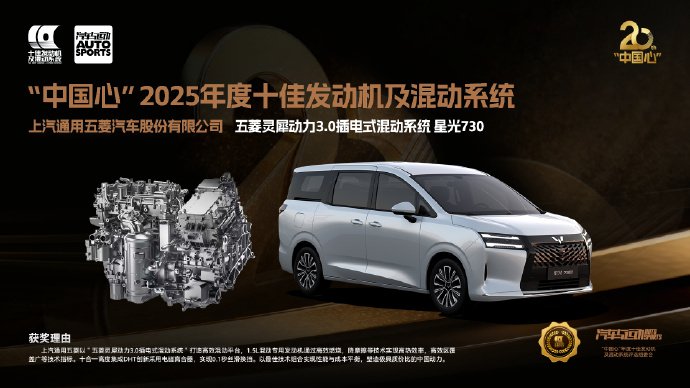
The plug-in hybrid 125 km Luxury trim is equipped with the Lingxi Power 3.0 system:
1.5L hybrid-dedicated Atkinson cycle engine with a maximum thermal efficiency of approximately 42.7–43.2%;
Fourth-generation 10-in-1 high-efficiency hybrid e-drive, highly integrating the motor, reducer, DC/DC, OBC, etc.;
CLTC pure electric range of 125 km, combined range of 1100 km, and fuel consumption of 5.3 L/100 km under depleted battery conditions.
From a systems engineering perspective, several points are worth noting:
Highly integrated e-drive: The benefit of the 10-in-1 is fewer parts, shorter wiring harnesses, unified thermal management, advantages in packaging space and curb weight, and simpler assembly. The trade-off is a high degree of modularity — when problems occur, assembly-level repair may be needed, raising the cost of a single later repair.
High thermal efficiency engine: The hybrid-dedicated engine mainly operates in the high-efficiency range, not pursuing extreme power output but focusing on optimizing the entire fuel consumption map. During calibration matching, the engine's intervention timing, speed, and load control must find a balance between "perceived sound" and fuel consumption.
Energy path: In urban conditions, electric drive dominates, with the engine taking on more of the roles of power generation and direct drive at medium-to-high speeds. With 125 km of pure electric range, for the vast majority of daily commutes (20–30 km one way), it is basically possible to only charge and never refuel in daily use.
This system has already been mass-production-validated on multiple Wuling models, with a certain foundation in reliability and calibration maturity. Applying it to the Starlight 730 is more about a change of body and usage scenario.
3. Pure electric version: 60 kWh Shenlian battery + 2C fast charging
The pure electric 500 km Luxury trim features single-motor drive with a maximum power of 100 kW, equipped with a 60 kWh lithium iron phosphate "Shenlian Battery," CLTC range of 500 km, 2C charging rate. Official figures state approximately 200 km of range can be replenished in 15 minutes, with energy consumption of approximately 13.6 kWh/100 km.
The Shenlian Battery has already seen large-scale installation across Wuling's lineup. The overall approach is:
Structurally, through the cell "Wending" structure, multi-layer protective design, and multi-needle puncture testing, improving the cell's resistance to thermal runaway;
At the system level, relying on BMS and cloud monitoring for real-time diagnosis and early warning of temperature and voltage anomalies.
The keywords are safety first, adequate energy density, and controllable cost. Applied to a family MPV, the goal is not to pursue extreme lightweighting and performance, but to ensure controllable thermal safety and reasonable energy consumption.
IV. Chassis and Ride: Front McPherson + Rear Multi-Link, Tuned Around "Motion Sickness Resistance"
The Starlight 730 adopts a front McPherson, rear multi-link independent suspension layout, which is not common in 100,000-yuan-class MPVs — many same-price competitors still use a rear torsion beam structure.
The advantages of this suspension combination are mainly reflected in two aspects:
Better decoupling of lateral and longitudinal forces at the rear axle: Multi-link allows more freedom in controlling camber and toe change curves. Under fully loaded and cornering conditions, it can both suppress body roll and retain a certain level of comfort — especially important for an MPV with a higher center of gravity.
Easier control of floor height: The plug-in hybrid and pure electric versions need more space near the rear axle for the battery/fuel tank. Independent suspension helps make the floor lower while ensuring suspension travel, improving third-row seating posture and ease of entry/exit.
The manufacturer mentions that the engineering team finely tuned 24 bushing stiffness points on the rear suspension, with the goal of reducing harshness and the probability of motion sickness. Simply put, by distributing rubber bushing stiffness, damping, and preload, high-frequency vibrations are filtered out while avoiding the "boat-rocking" feeling caused by low-frequency large-amplitude oscillations.
No particularly emphasized "black technology" has been seen yet for the steering and braking systems. The overall style can be judged as prioritizing comfort and stability, not deliberately pursuing driving fun, but likely easy to live with in daily family use.
V. Electronics and Scenarios: Adequacy First, No Chase for High-Level Autonomous Driving
Not much has been disclosed about the Starlight 730's electronic and electrical architecture. From the configuration, the vehicle's intelligentization strategy is "functions in place, no stacking for the sake of it."
The infotainment section features a 12.8-inch central control screen supporting phone connectivity. Scenario modes such as nap, camping, and stay-powered when leaving the vehicle lean toward practicality.
On the autonomous driving front, it mainly offers conventional L2-level assistance (adaptive cruise, lane assist, etc., depending on trim), without high-compute chips or city NOA-type selling points.
Power management supports parking power supply and simple camping scenarios, without deliberately emphasizing complex features like high-power external discharge.
For the target audience of a 100,000-yuan-class family MPV, the real essentials are space, safety, stability, and running costs. High-level autonomous driving is not a key decision factor. Skipping a high-compute domain controller instead allows more budget to be allocated to body structure, powered sliding door mechanisms, seats, and NVH — parts that more directly affect the experience.
VI. Conclusion from an Engineering Perspective: Money Spent in the Right Places
From an engineering perspective, the Starlight 730 is not the kind of car that attracts attention by stacking specs and flashy features, but it is clear that the R&D budget is concentrated in several core areas:
Architecture level: Native Tianyu platform + one car, three powertrains, improving parts commonality and long-term maintenance convenience.
Structural safety: Six-ring high-strength steel cage body, 75.6% high-strength steel, 1500 MPa hot-formed steel, aluminum alloy crash beam, and engine drop structure — the cost of these invisible areas is not low.
Energy consumption and thermal management: Lingxi Power 3.0 high-thermal-efficiency hybrid system, Shenlian Battery's safety and 2C fast charging capability, and a 0.276 drag coefficient — all providing tangible help for long-term running costs of plug-in hybrid and pure electric versions.
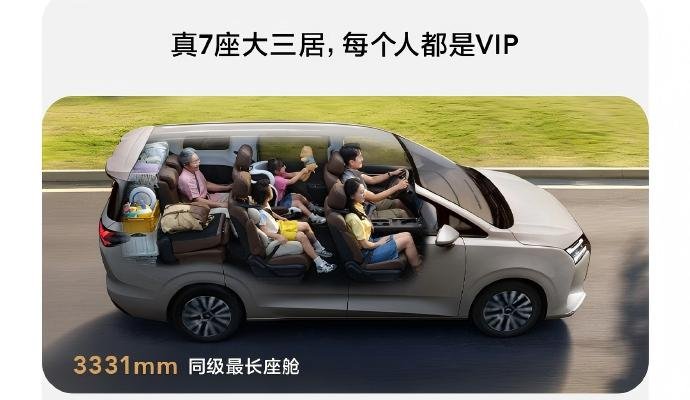
Usage scenarios: 2+2+3 true seven seats, high space utilization, 230 mm aisle, powered sliding doors, low threshold, and B-pillar grab handles — the details are basically aimed at typical users such as the elderly, children, and multi-person families.
Areas needing subsequent real-vehicle verification are also fairly clear: NVH level, thermal degradation during fully loaded hill climbs, and actual energy consumption performance of plug-in hybrid and pure electric versions in extreme climates (high heat, severe cold). Additionally, users need to have psychological expectations about the repair cost of the 10-in-1 highly integrated e-drive in the event of a single-point failure later on.
Overall, in the 70,000–110,000 yuan range that is extremely cost-sensitive, the Starlight 730 did not pour its budget into high-level autonomous driving and "looks luxurious" decorations, but instead prioritized body structure, safety, energy consumption systems, and key family scenarios. This kind of prioritization is a relatively pragmatic and more engineering-oriented approach for an MPV focused on family users.


